Science-Backed Sales Techniques: Objections, Soft Nos and What Not to Say
What published research says about handling objections and soft nos, with the exact words to use and the phrases to drop. Every claim names its study and its limits.
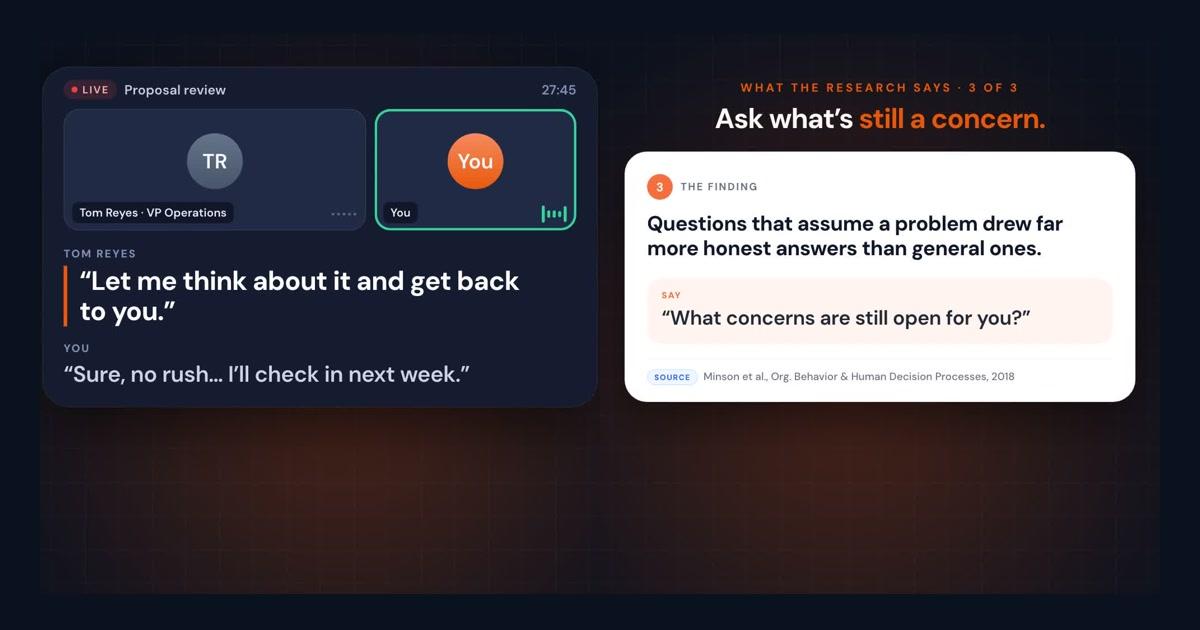
The buyer says "let me think about it and get back to you." Most of us answer "sure, no rush, I'll check in next week." Then the deal goes quiet.
Sales advice is full of confident rules for that moment, and most of them come with no evidence at all. So we went to the published research on negotiation, persuasion and conversation and kept only what the studies support. Below are the techniques that held up, the exact words to use, and what to stop saying. One warning up front: almost all of this research was done in labs and service desks, not on B2B sales calls. We say what each study looked at so you can judge it yourself.
Here is the soft no, and three moves for it, in 36 seconds:
Handling an objection: wait three seconds
When a buyer objects, the instinct is to answer fast, before the silence gets awkward. The research points the other way.
In negotiation studies at MIT, silent pauses of at least three seconds led to better deals for both sides. The researchers found that the silence moved people into a more deliberate frame of mind (Curhan and colleagues, 2022).
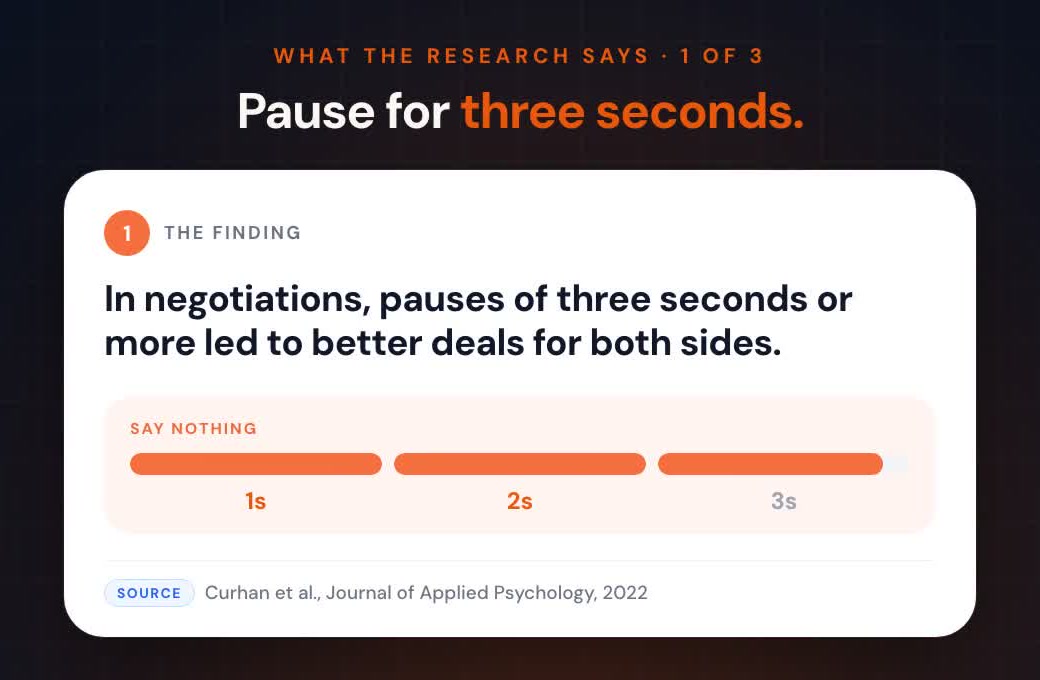
Two honest limits. The gain was shared, so this is not a pressure tactic, and nothing in the study says the quiet side won more. And these were negotiation exercises, not sales calls.
There is a sales-specific data point, with a label on it. Gong's analysis of its own customers' calls reported that top reps pause longer after an objection than average reps, and answer an objection with a question more often (54.3% of the time against 31.0%). That is a vendor's analysis with no published methods, so treat it as a hint, not proof.
Try it: when you hear the objection, count three seconds in your head before you speak. It feels long to you and normal to the buyer.
Show you heard them before you answer
A good counter-argument delivered too early sounds like you weren't listening.
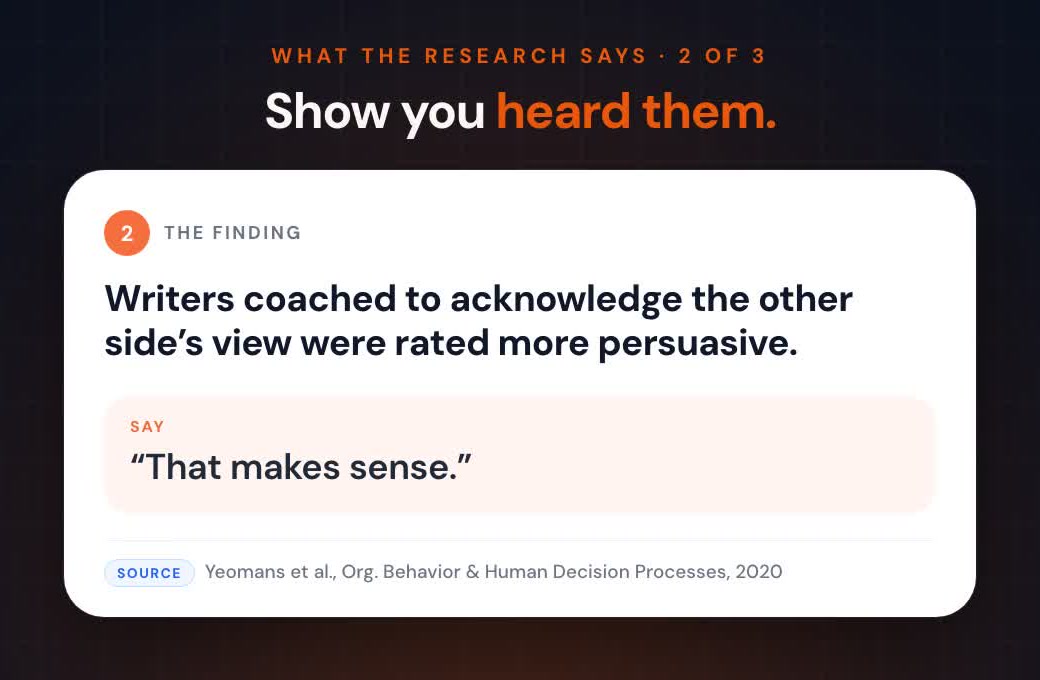
In a 2020 study, writers who were coached to acknowledge the other side's view were rated more persuasive by the people who disagreed with them. The coaching had four parts: say you understand, find a point of agreement, use positive statements instead of negations, and soften your claims a little (Yeomans and colleagues, 2020).
The same study found what makes a reply sound closed: "no", "wrong", and long chains of "because" and "therefore". The limit here is that the study used written messages about contested topics, not live conversation.
Try it: "That makes sense. Budget is tight this quarter." Then your question or your answer.
Handling a soft no: ask what is still a concern
A soft no is a decline that doesn't use the word. "Send me some information." "Let's circle back next quarter." "I need to run it by the team." The usual reply is "any questions before we wrap up?", and the usual answer is "nope, all good."
How you phrase the question changes how honest the answer is. In face-to-face mock meetings with 101 people, each person was holding back a problem. Asked a general question, 12.1% admitted it. Asked a question that assumed everything was fine, 39.4% did. Asked a question that assumed there was a problem, 100% did (Minson and colleagues, 2018).
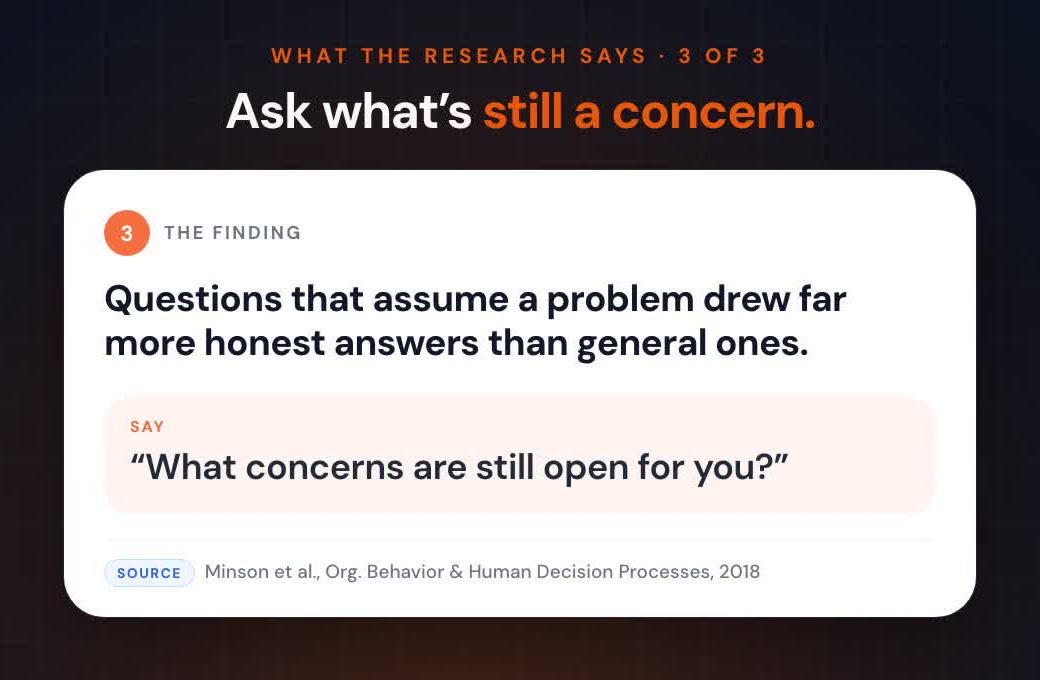
The limit: this was a lab exercise about a hidden problem, not buyers in a deal. The same paper also found that pushy assumptions about unlikely things made the asker look worse, so assume a concern, not a sin.
Try it: replace "any questions?" with "What concerns are still open for you?"
Ask follow-up questions
People who ask more questions are liked more, and follow-up questions do most of the work. Across 398 people in online chats, those told to ask at least nine questions were liked more than those held to four. In a second study of speed dates, follow-up questions were the only kind that predicted a second date (Huang and colleagues, 2017).
The effect was small, and these were strangers getting acquainted. But the mechanism fits a sales call: a follow-up question is proof you heard the last answer. A list of prepared discovery questions isn't.
Try it: before your next prepared question, ask one about what they just said. "You said the rollout slipped twice. What happened the second time?"
What not to say on a call
| Stop saying | Say this | Why |
|---|---|---|
| "Sure, no rush. I'll check in next week." | (Three seconds of nothing.) "That makes sense. What concerns are still open for you?" | Pause, acknowledge, then ask the question that assumes a concern. |
| "No, but..." or "Actually, that's not right." | "That makes sense. Here is how other teams handled it." | "No" and "wrong" were markers of a closed reply in the Yeomans study. |
| "Any questions?" or "Sounds good, right?" | "What concerns are still open for you?" | General questions drew the fewest honest answers in the Minson study. |
| "We'll look into that." | "I'll send the onboarding plan by Thursday." | See below. |
| "It's probably around, I think, maybe 40k?" | "It's 40,000 a year." | See below. |
Vague and "we". In customer service research, agents who used more concrete language had more satisfied customers who went on to spend more. Agents who said "I" instead of "we" saw more follow-on purchases (Packard and Berger, 2021; Packard, Moore and McFerran, 2018). That was service calls and emails, not sales, and the data shows a link, not a cause. Still, "I'll send it by Thursday" costs nothing to say.
Hedging your price. When a topic mattered to listeners, hedges, hesitations and tag questions each made the speaker less persuasive (Blankenship and Holtgraves, 2005). This one needs care, because the Yeomans study above found that softening a claim helps when you disagree with someone. The two fit together like this: soften your disagreement, never your price or your next step.
What the research doesn't say
None of these studies measured a win rate, a close rate or revenue. Anyone who tells you a phrase "doubles your close rate" is quoting a number that doesn't exist. Two popular claims we checked and threw out:
- "87% of sales training is forgotten in 30 days." The real source is a 1979 report of an unpublished Xerox study. It had no 30-day window and no published method.
- "But you are free to say no" doubles agreement. The doubling comes from one street study of 80 people. Later reviews of the wider evidence found a small effect or none.
Why knowing this isn't enough
You have now read six techniques. In a week you will remember some of them, and on your next hard call you will use fewer.
That is also a research finding. In a well-known memory experiment, students either re-read a passage or were tested on it. After five minutes the re-readers were ahead. A week later the tested group recalled 56% and the re-readers 42% (Roediger and Karpicke, 2006). Re-reading feels like it works, and pulling the thing out of your own head is what makes it stick.
For skills specifically, a review of 117 studies of workplace training found that knowledge faded but skills and on-the-job behavior held up, most of all when people practiced their own situations and saw both good and bad examples (Taylor, Russ-Eft and Chan, 2005).
A three-second pause is easy to agree with on a page. Holding one while a VP is waiting for your answer is a different thing, and the only way to get there is to do it out loud a few times first.
Practice it on Salesably
That last part is what Salesably is for. To be clear, none of the studies above tested Salesably. They are the reason we built practice the way we did.
In Objections Gym you pick an objection, such as "let me think about it", and say your reply out loud to an AI buyer who pushes back the way a real one does. Run it as open practice until the pause and the question feel natural. Then take the scored version and see your result out of 100, with what worked and what to change.
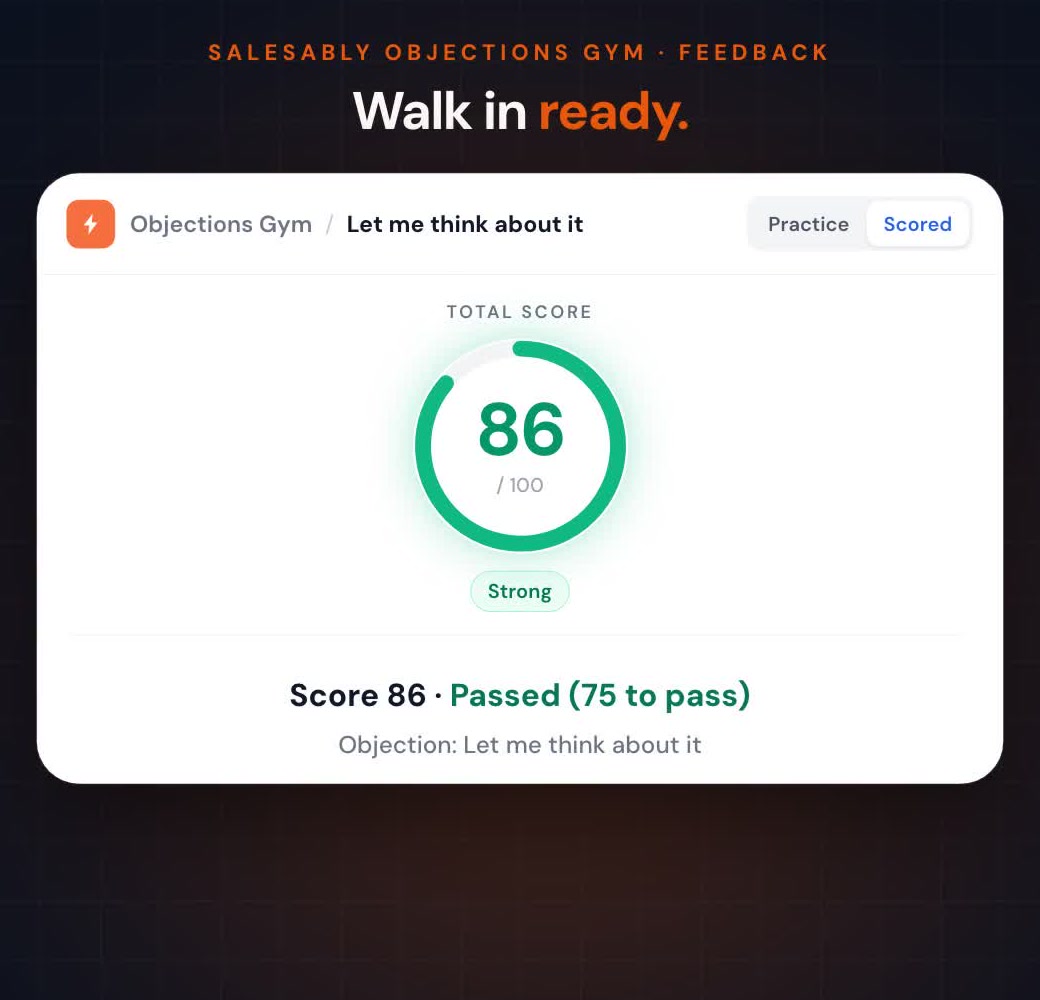
The call and the score in these images are a demo.
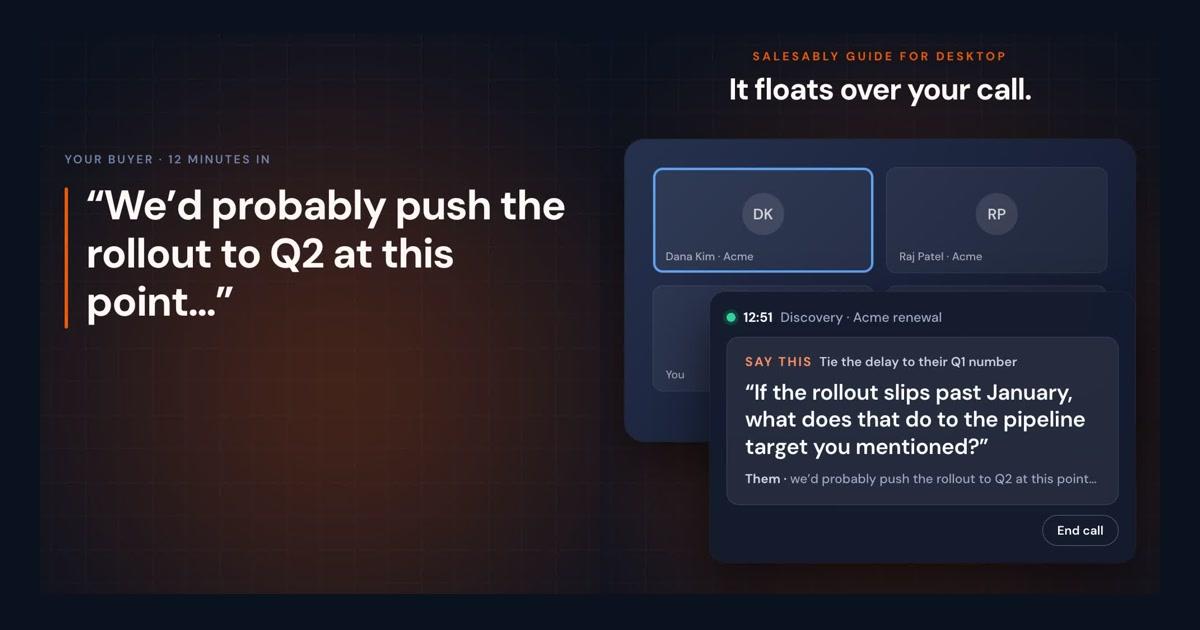
On real calls, Guide, our live call coach, listens along and names a soft no when it hears one, so you get the cue to slow down in the moment and not in the car afterwards.
Pick the one objection you dread most and practice your reply five times before your next call. Book a demo and see how you sound different.
Sources
- Curhan, Overbeck, Cho, Zhang and Yang (2022). Silence is golden: Extended silence, deliberative mindset, and value creation in negotiation. Journal of Applied Psychology, 107(1). doi:10.1037/apl0000877
- Yeomans, Minson, Collins, Chen and Gino (2020). Conversational receptiveness: Improving engagement with opposing views. Organizational Behavior and Human Decision Processes, 160. doi:10.1016/j.obhdp.2020.03.011
- Minson, VanEpps, Yip and Schweitzer (2018). Eliciting the truth, the whole truth, and nothing but the truth: The effect of question phrasing on deception. Organizational Behavior and Human Decision Processes, 147. doi:10.1016/j.obhdp.2018.05.006
- Huang, Yeomans, Brooks, Minson and Gino (2017). It doesn't hurt to ask: Question-asking increases liking. Journal of Personality and Social Psychology, 113(3). doi:10.1037/pspi0000097
- Packard and Berger (2021). How concrete language shapes customer satisfaction. Journal of Consumer Research, 47(5). doi:10.1093/jcr/ucaa038
- Packard, Moore and McFerran (2018). (I'm) Happy to help (you). Journal of Marketing Research, 55(4). doi:10.1509/jmr.16.0118
- Blankenship and Holtgraves (2005). The role of different markers of linguistic powerlessness in persuasion. Journal of Language and Social Psychology, 24(1).
- Roediger and Karpicke (2006). Psychological Science, 17(3). doi:10.1111/j.1467-9280.2006.01693.x
- Taylor, Russ-Eft and Chan (2005). A meta-analytic review of behavior modeling training. Journal of Applied Psychology, 90(4). doi:10.1037/0021-9010.90.4.692
- Gong Labs, analysis of its customers' sales calls (industry data, not peer reviewed). gong.io/resources/labs/handling-sales-objections
Author

Vidal Graupera
Vidal is the Founder of Salesably, focused on using AI to elevate human skills in sales training and enablement. He has extensive experience in building platforms that leverage artificial intelligence for sales improvements.
Table of Contents
Free Sales Training Guide
Download our comprehensive guide to building effective sales training programs that drive results.
AI Sales Training Template: 2026 Edition
PDF Guide • 16 pages • 3.0 MB
We respect your privacy. Unsubscribe at any time.